Rabbinate
Organizes actions: develops the scenario and ritual form, brings participants together, establishes the order, and conducts the event.
Moscow · since 2010
An order-structured art group that created Moscow Neo-Sabbateanism ↗ and enacts its propositions through artistic and ritual practice.
withinMoscow01 / Origins
Tariqa Shabbat was founded in Moscow in 2010. The art group operates at the intersection of contemporary art, collective ritual, and religious-philosophical production.
The group investigated how repeated ritual affects the everyday lives of metropolitan residents: how a shared practice changes relationships between participants, builds a community, and connects the religious calendar with urban experience.
Initially, the collective developed forms for observing Shabbat and other dates in the Jewish calendar. Gradually, these events became autonomous artistic and ritual practices. Their repetition, documentation, and interpretation produced a distinct method and subsequently led to the formulation of Moscow Neo-Sabbateanism ↗ as an independent doctrine.
The group worked across different media and techniques, including performance, collective ritual, installation, photography, video, text, printed matter, and online actions. The medium was chosen for each particular form of interaction and could change from one event to the next.
02 / Structure
Rabbis and elders differed not in status but in their function within the group’s practice. Rabbis were the participants who organized actions: they developed scenarios and ritual forms, brought participants together, established the order, and conducted events. At different times, the elders contributed to the formation of the doctrine, discussed and interpreted practices, and preserved the group’s collective memory. Every elder took part in the creation of Moscow Neo-Sabbateanism, each during their own period of involvement. The roles nevertheless remained fluid and did not form a fixed hierarchy.
Organizes actions: develops the scenario and ritual form, brings participants together, establishes the order, and conducts the event.
At different times, every elder participated in creating and developing the doctrine, interpreted the group’s practices, and preserved its collective memory.
Enacts the proposed form, transforming it into a collective artistic experience.
Method
A method for temporarily transferring the function of rabbi from one participant to another. The Rabbi’s Balloon redistributes the right to determine the form of collective action, making the shift in authorship part of the ritual itself.
03 / Structure
The rabbis organized and conducted actions. At different times, every elder participated in shaping the group’s doctrine.
Organizes actions: develops the scenario and ritual form, brings participants together, establishes the order, and conducts the event.
At different times, every elder participated in creating and developing the doctrine, interpreted the group’s practices, and preserved its collective memory.
04 / Archive of Actions
Tariqa Shabbat’s actions have taken place in Moscow and other cities, as well as online. The Passover Seder series brings together rituals from different years; the most recent took place in Berlin in 2026.
Local actions, collective rituals, and events bound to a specific place of physical presence.
The catalogue remains under reconstruction. Further actions will be added as archival materials are attributed.
Distributed events whose participants enacted a shared ritual form simultaneously across different cities and countries.
05 / Material Archive
Written works, documents, and visual evidence produced through Tariqa Shabbat’s activity.
Two collectively authored documents occupy a particular place in the archive: Kabbalat Shabbat and the Neo-Sabbatean Passover Haggadah.
They are used during actions convened by the group but are not limited to them. Any ritual performed by anyone using either document becomes an action by Tariqa Shabbat and a ritual of Moscow Neo-Sabbateanism ↗.
A collectively authored liturgical and performative document that establishes the sequence of Shabbat. Its use outside the convened programme also constitutes an autonomous action by the group.
download DOCX ↓A collective redaction of the Passover narrative and a score for ritual action. The document may be used independently, bringing any Seder conducted with it into the group’s field of artistic practice.
download DOCX ↓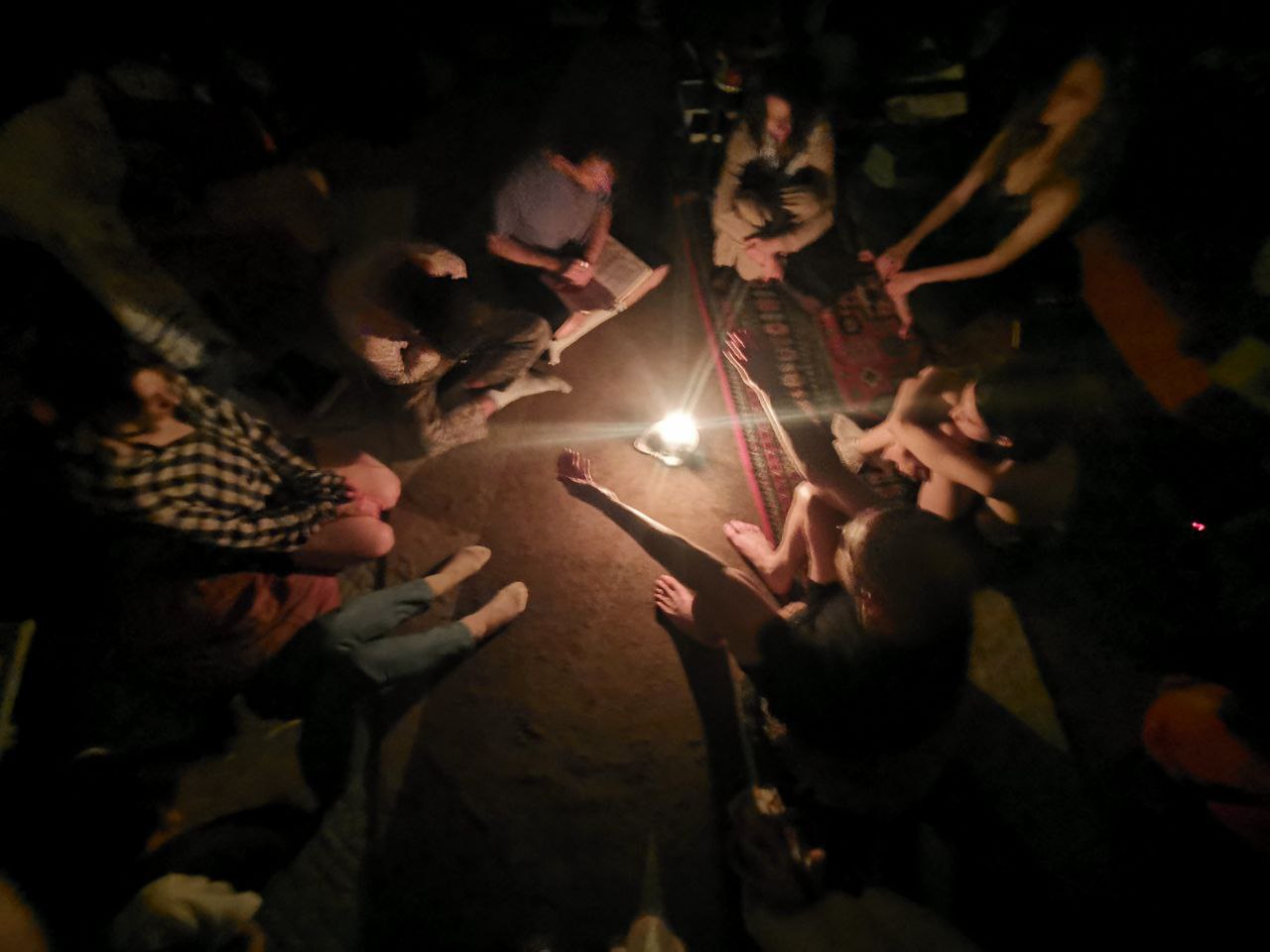
Visual evidence of the online action held on 9 June 2023, on the eve of the Shabbat of the weekly Torah portion Beha’alotcha.
open image ↗06 / Action and Doctrinal Proposition
Every action, Shabbat, and conversation of Tariqa Shabbat was systematically documented by the elder Tapir Bey. After his death, the archive he had assembled disappeared under circumstances that remain unexplained.
The loss of the archive was incorporated into the group’s artistic and theoretical system. The Lost Archive exists simultaneously as an ongoing action and as a proposition of Moscow Neo-Sabbateanism ↗.
The archive manifests through absence: surviving fragments, individual testimony, renewed descriptions of events, and attempts at reconstruction become new parts of the work. The disappearance of documentation does not conclude the archive; it transfers it into another mode of existence.
07 / Doctrine
Developed by the group, Moscow Neo-Sabbateanism ↗ did not precede its practice as a ready-made doctrine. It emerged through the interpretation of rituals and actions produced by the collective and subsequently became the methodological basis of its further activity.
Tariqa Shabbat thus produces Moscow Neo-Sabbateanism while simultaneously operating within the system it created. The doctrine is not limited to the membership or history of the art group and may exist independently of it.
visit the doctrine website ↗